

Ask a developer on a small team what they should work on next and you will usually get a pause, followed by some combination of scanning a board, remembering a conversation, and guessing.
That pause is expensive, and it repeats every time somebody finishes a ticket.
One list has to answer two different questions
A single backlog is asked to serve two people with different jobs.
A project manager is asking: of everything this project could do next, what matters most? That is a question about the project, and it changes when a client escalates something or a dependency lands.
A developer is asking: of the things that are mine, what do I pick up now? That is a question about one person’s capacity, and it should not require re-reading the whole project to answer.
Merge those into one list and you get the failure mode every small team knows: the board is technically correct and nobody trusts it. Priority gets communicated in chat instead, which means it is not written down anywhere, which means the board drifts further from reality, which means people trust it less.
Splitting them
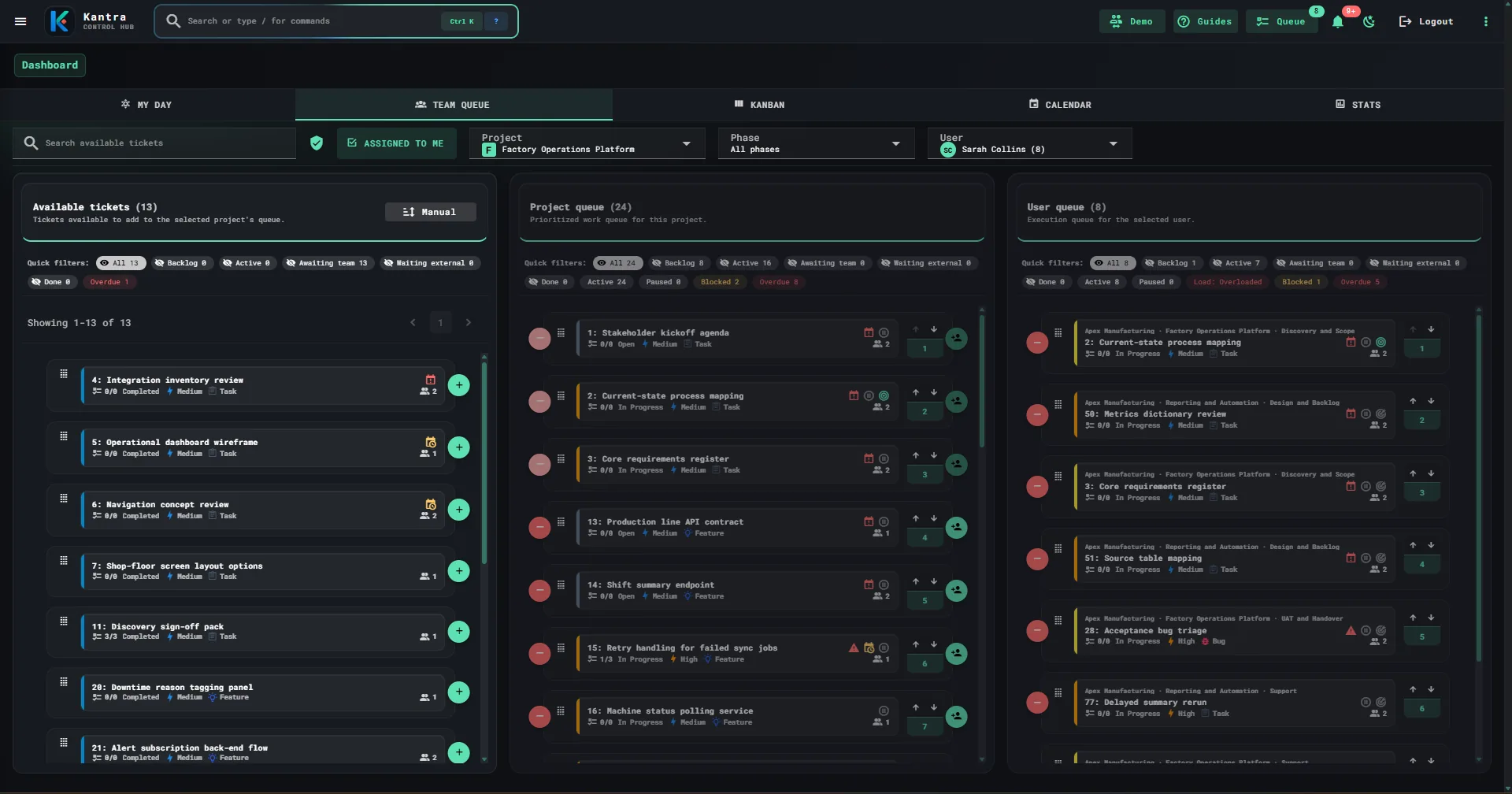
Kantra keeps a project queue and a per-person queue as separate things.
The project queue is the priority slice — the manager’s answer to “what matters most here”, ordered deliberately. The personal queue is what has actually landed on you. A developer works the top of their own list without needing to hold the entire project in their head, and a manager reorders priority without having to negotiate with six individual workloads to do it.
The team view shows both side by side, plus what is unassigned and available. You can see where every person is without asking them.
What it actually buys you
Less noise, and less guessing. But the specific thing worth naming is that priority becomes written down instead of remembered.
Once the project queue is the real answer, “what should I pick up next?” stops being a conversation. That is a small change per instance and a large one in aggregate, because it was happening several times a day per person and none of it was billable.
Kantra is live and open for signups. Start a workspace free for a month, or read more about how it fits together.