

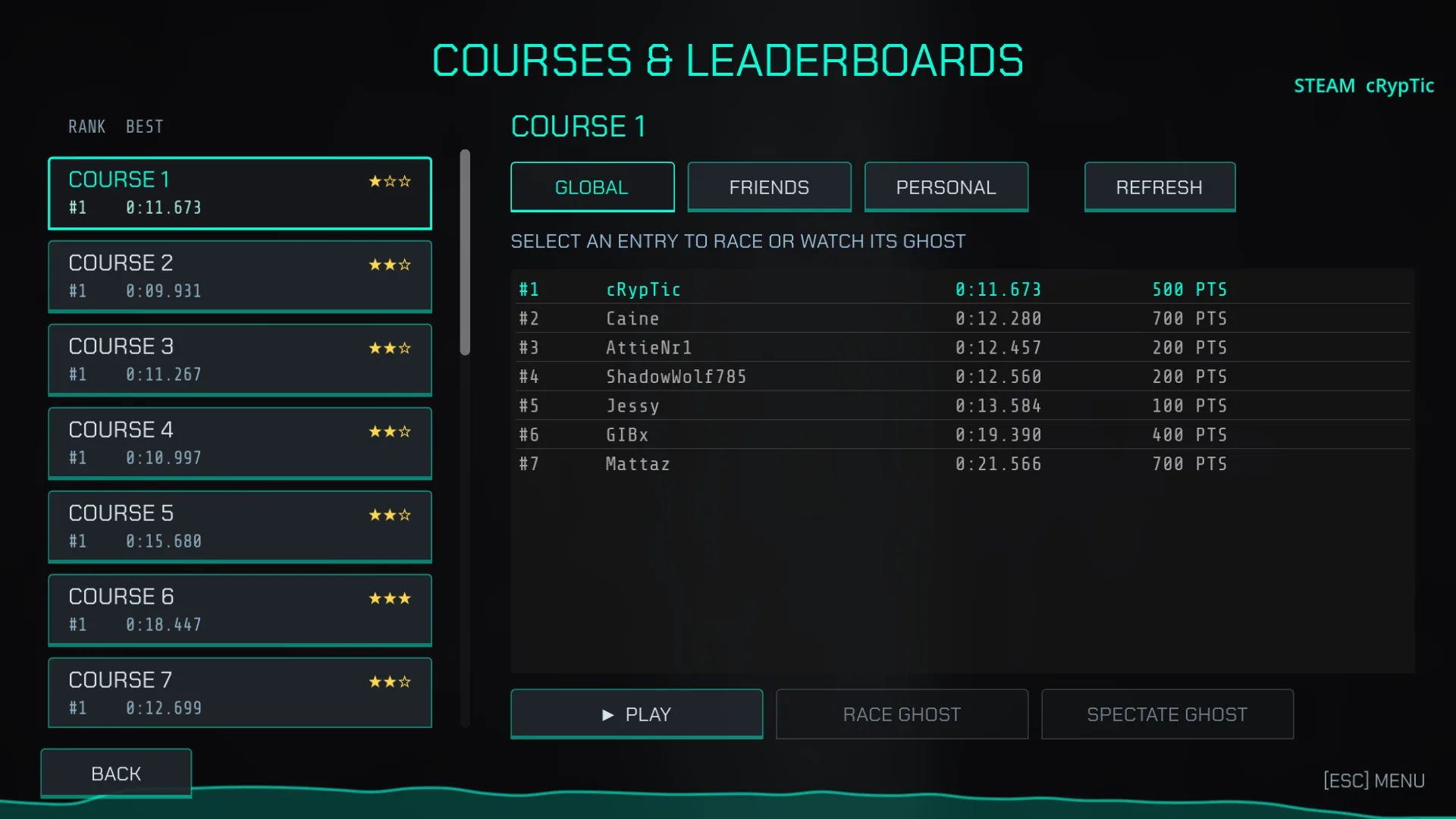
Early Access was on the table for months. We decided against it, and the reasoning is worth writing down — partly because both of the arguments for it dissolved on their own, and partly because what finally decided it was a cost nobody talks about.
The two arguments for it both evaporated
The first was content confidence. Courses 6 through 10 were the newest and least proven, and Early Access is the obvious hedge when you are not sure a course is good. That stopped being true once outside testers started setting competitive times on them. A course somebody is actively grinding for a leaderboard position is not a course that needs more feedback before release.
The second was the art style. It is easy to mistake “deliberately minimal” for “unfinished”, and for a while we were not certain which one we had. We are now. The style is settled — it reads at speed, which is the only thing it has to do.
What actually decided it
Early Access costs you things a Playtest does not, and the biggest one is the launch visibility spike.
That spike is the largest push Steam will ever give the game, and it fires exactly once. Going into Early Access spends it — and spending it with no wishlist bank behind you means firing it into an empty room. You do not get a second one at 1.0.
Two more, smaller but permanent:
- The review score starts immediately. An Early Access review score follows the game forever, and it is collected during the period when the game is least finished.
- Wishlists convert differently. Early Access turns a wishlist bank that would have detonated on launch day into a slow trickle of sales spread across months. The same units, minus the concentration that makes the algorithm notice you.
None of that is a problem if the game genuinely needs to grow with its players. Rushmark does not. Ten courses, three modes, a tutorial, leaderboards, rival ghosts, achievements, cosmetics and full controller support — it is a finished thing, so it ships as one.
On the price
$9.99, with purchasing-power regional conversions rather than straight exchange-rate ones.
An earlier draft of this reasoning had the comparables wrong. We assumed the genre clustered around $5–8. It does not. Super Meat Boy, N++, Clustertruck and SpeedRunners are all $14.99. Celeste is $19.99, Neon White $24.99. Dustforce at $9.99 and VVVVVV at $4.99 are the floor, not the middle. So $9.99 is conservative for ten courses plus two extra modes, leaderboards, rival ghosts and cosmetics — more than several of those shipped with.
We considered $7.99 and rejected it. In the $8–15 band indie demand is fairly inelastic: a $2 cut rarely returns the ~25% extra units it needs to break even. Visibility drives units, not price. And starting lower costs you discount headroom later, which is the thing that actually moves copies in a sale.
Rushmark releases at the end of September 2026. Wishlisting it on Steam is genuinely the single most useful thing you can do for a game at this stage — it is the number that decides how big that one spike gets.