

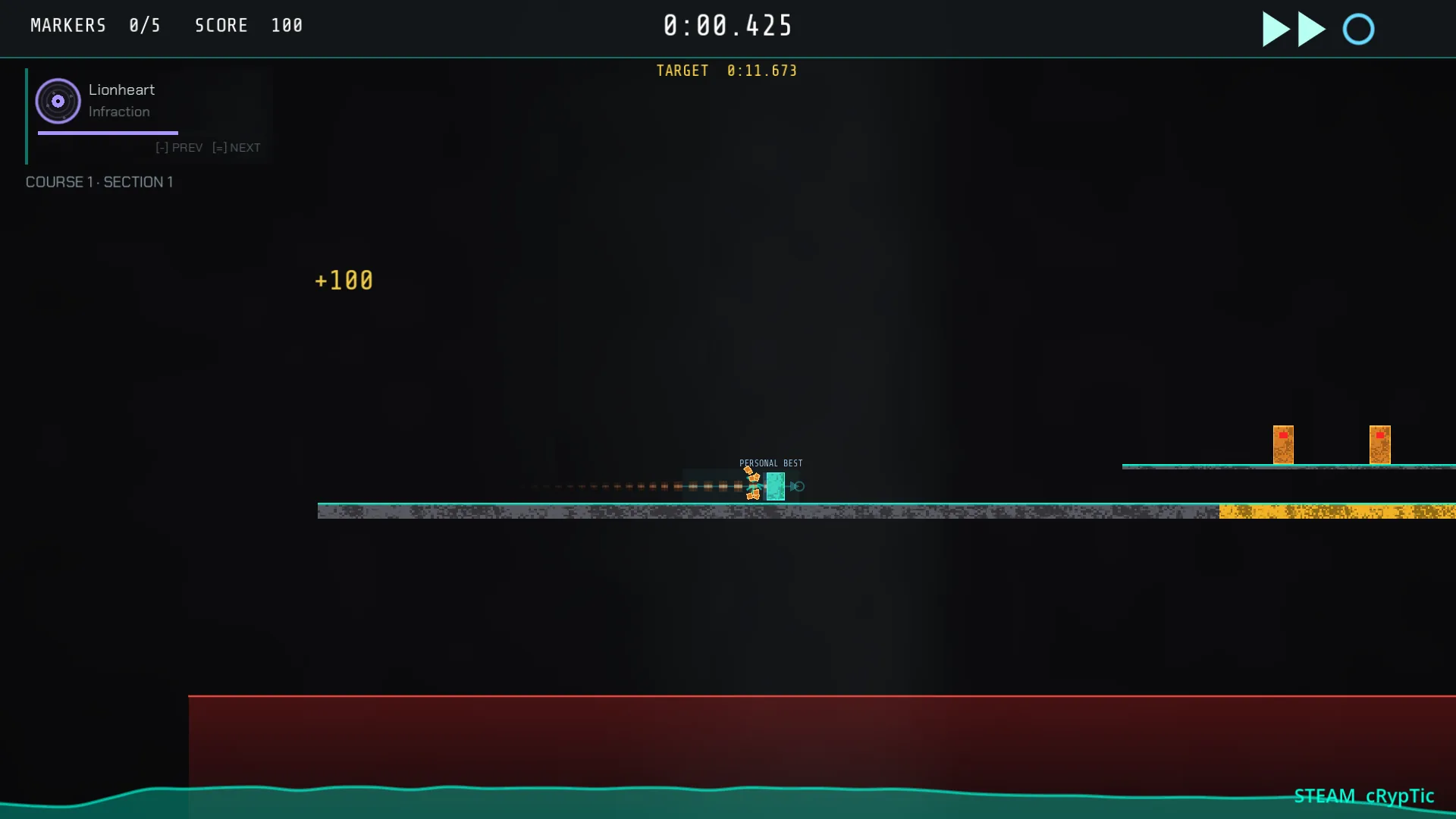
Rushmark has a surface called sticky ground. The design intent is simple: it is the one lever that reliably makes a lane slower, so a level designer can offer a short muddy route against a long clean one and have that be a real choice.
It was not doing its job. It had not been doing its job on shipped content for some time.
Two leaks, and the obvious one was the smaller one
Sticky works by capping the movement target at 420 and approaching it with friction. The dash does not go through that path at all — it writes velocity outright. So per dash cycle you got about 168 px from the burst itself, and about 346 px from the exit carry, because the dash ends around 1350–1400 and friction takes nearly four tenths of a second to drag that back down. You travel the whole way while it does.
That is roughly 925 px/s against 420 for wading. Measured on a shipped course’s low lane, plain dash-spam gave up 613 px in 2.5 seconds — so this was never a quirk of new geometry, it was live in content players had already been running.
Hopping escapes sticky too, but that half is deliberate: leaving the ground releases you immediately so the surface never feels like a soft lock. We checked whether a low ceiling could close that loophole. It cannot. A jump that gets reliably stuffed by a ceiling still breaks ground contact, which is all sticky needs to let go. A 20 px roof let hop-spam beat both lanes of a test section; 4 px cut it to about a third of a second but never closed it. Geometry was the wrong tool.
The fix is a clamp, not another special case
The temptation is to add a branch to the dash. We put a hard cap in the physics step instead, between the state machine and the move — horizontal only, grounded only.
That placement is the actual fix. Every movement state is covered at once, rather than each new one having to remember to respect sticky, which is precisely how the dash slipped through in the first place. Dash-spam’s advantage dropped from 613 px to 139 px.
The same root cause explained two other oddities
Because the dash overwrote velocity rather than adding to it, it was quietly acting as a normaliser. It topped you up when you were slow — 420 off sticky became 1400. But it also cut you down when you were fast: come off a boost pad at 1650 and the dash dropped you to 1400.
Combining mechanics was being punished. Doing the clever thing made you slower.
It now floors against the speed you were already carrying along the dash direction, on entry and on exit, so it can only ever raise you. No certified route got shorter.
It does not fix diagonals. A 45° dash from 1100 projects to 778, which is under the dash speed, so horizontal still wins at 990. Fixing that properly needs a per-axis additive dash, which means re-certifying every route — a post-1.0 job, not a five-weeks-from-launch job.
A latch bug found on the way
Teleporting never cleared the cached floor collider, and the refresh only overwrites on a tick that actually recorded a collision. So after a portal hand-off, every “am I on sticky / ice / boost?” question answered for the previous section’s terrain until the first collision at the destination.
That was survivable while sticky only nudged a movement target — the next tick corrected it. It stops being survivable the moment that answer hard-clamps your velocity. Cleared it in the teleport reset sweep, where it should have been all along.
The verification trap
Eight saved test routes failed afterwards. None of them was a broken section.
All eight are fixed-time input tapes. Change how fast a lane runs and every later input lands at the wrong position. One cleared again with its jump shifted 0.12 s later. Another needed a gate moved 0.6 s — which is exactly the sticky clamp doing its job.
Two things worth carrying forward. A uniform time offset only fits routes whose drift is constant; one weaving section needed a time scale instead, because the drift accumulates across many dodges. And the one section containing boost and sticky together resisted both, because it speeds up in one place and slows down in another.
The bigger trap: fitting a route in isolation is not the same as fitting it in the suite. Several sections destroy enemies the probe never respawns, and the player carries dash, overspeed and floor-latch state between cases. A tape can clear alone and still miss in a full-course run.
Confirmed by hand across all fifteen courses before committing. Dashing off a pad or out of a fall is noticeably better, and sticky finally reads as mud.